By Robecca Leyden.
UNERASED: MADE IN PALESTINE is an exhibition like no other.
Sitting just off Ponsonby Road, it’s striking by just how peaceful the Building is to walk into. The bright colours of the Artifacts sit in Cabinets and there is traditional Palestinian coffee as well as palestinian dates for the visitors. As I try both, I got talking to Volunteer behind the desk. I ask for Emily the artists I was interviewing for this project and she isn’t there today. Silently cursing my terrible timing skills, I ask the man if he could tell me a little about this project. His name is Maher Nazzal and he is Palestinian.
“Whenever we ask people why they want to help, there is nothing In it for you, you are on the other side of the world. You are not arabs, Muslim or Palestinian. What we hear back is always the same: It’s that you are people and you deserve to live”.
Maher’s words spoke to me and I thought about the people that were being erased right before our eyes, as I walked around.
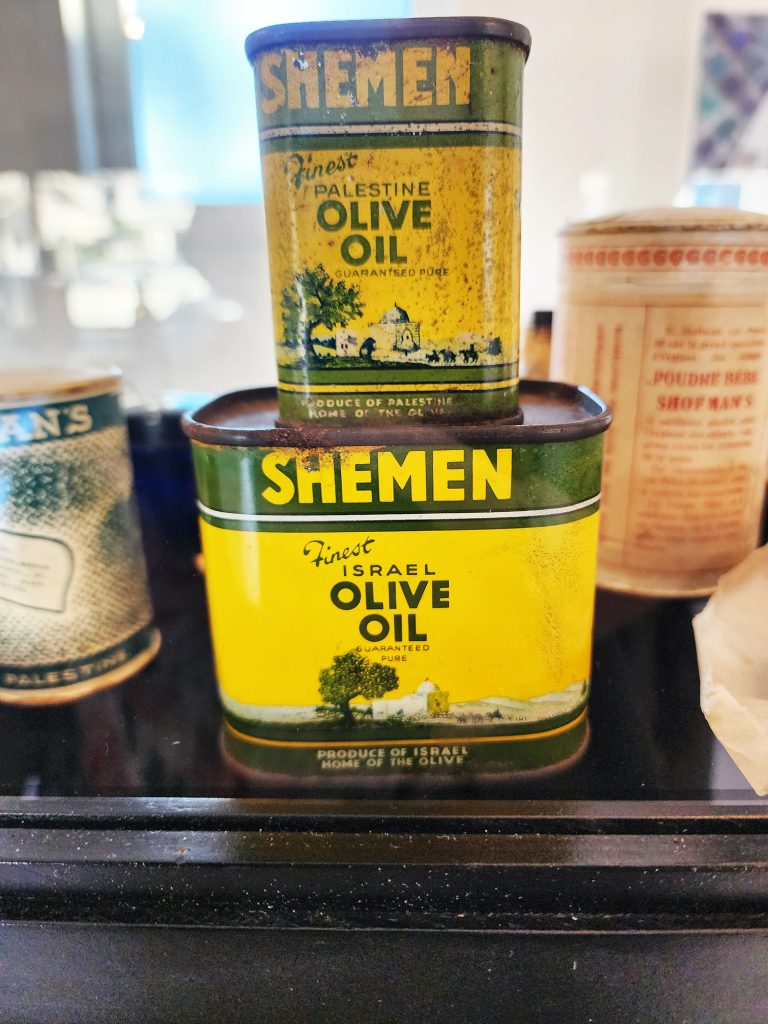
Pictured: Two olive oil cans exactly the same but one with Palestine and one with israel. Image by Sans Pareil Online.
Luckily i did Finally get to catch up with Emily Harley-Skudder and chat to her about this awe-inspiring Exhibition.
Hi Emily! Please tell us a little bit about yourself.
I’m a visual artist based in Te Whanganui-a-Tara Wellington. I make paintings, photographs, assemblages and installations which delve into the artificial ordinary and faux domestic. I work with mass-produced, everyday objects, often focusing on bathrooms, cosmetics and hygiene products—and the strange ways in which we try to control our bodies.
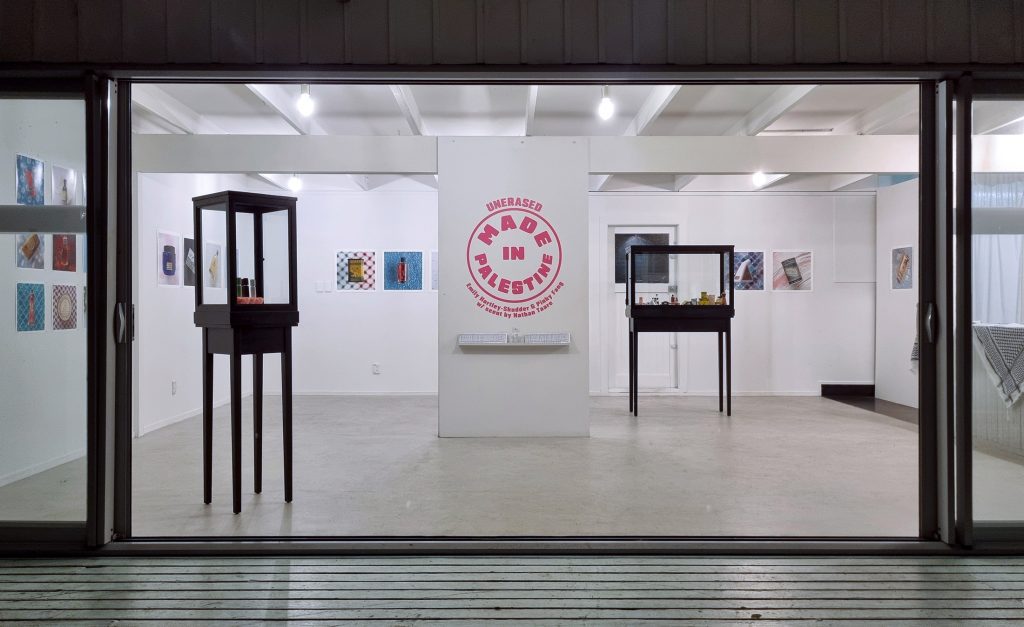
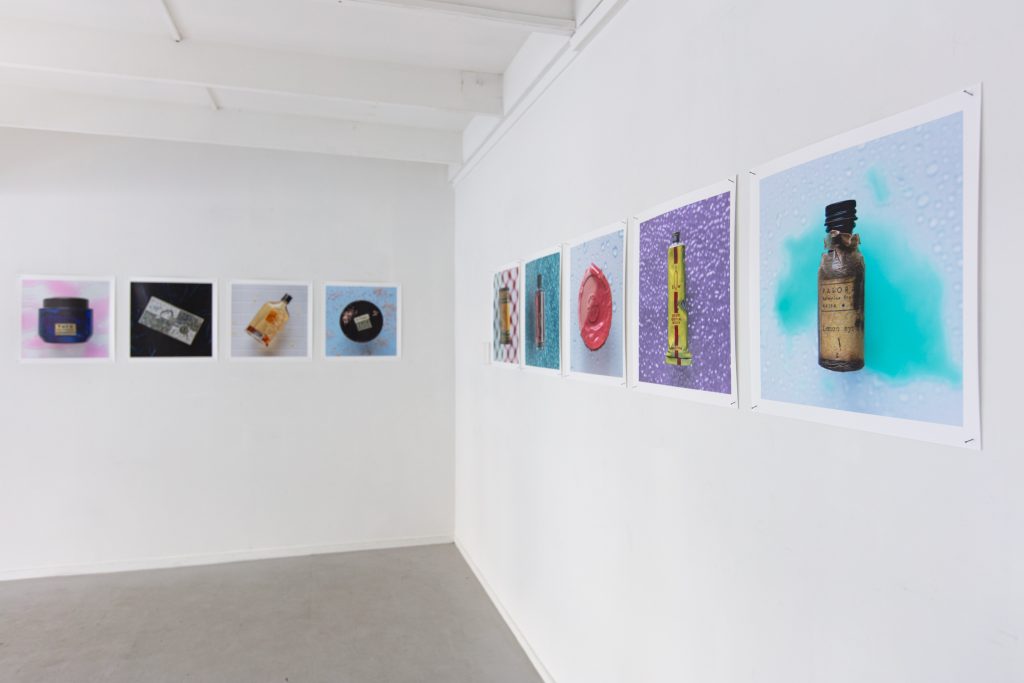
Pictured: the exhibition UNERASED: MADE IN PALESTINE. This image and all following images are provided by Emily Harley-Skudder.
This is such a fantastic project. How did it come about?
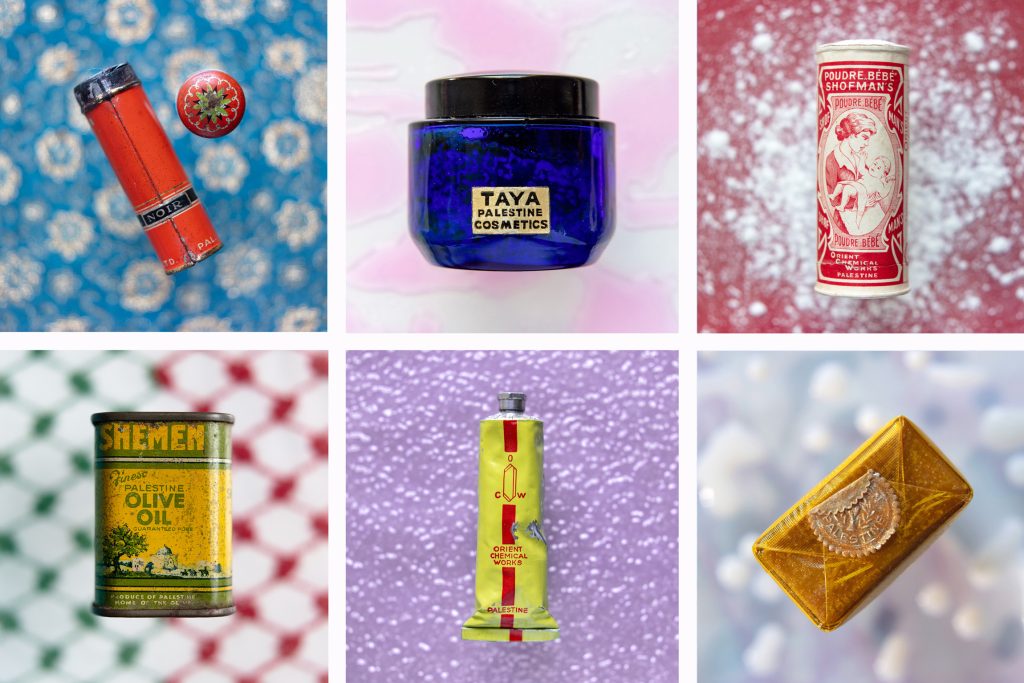
This project came about when my friend Pinky—who is an artist and activist with a background in illustration, design, sculpture, street art and DJing—discovered that some of the vintage cosmetics in her mum’s collection had ‘PALESTINE’ on their labels. Her mum had found them at an estate sale in the Hawkes bay in the 1970s. It turned out they had been imported by S.D.J. Cohen Manufacturers’ Agent and Importer; a shop that opened in 1931 in Hastings, New Zealand.
We knew we had to do something with these amazing artefacts to draw attention to the history of Palestine, and use them as a starting point to learn about the industrial and capitalist dimensions of the occupation. Pinky had already created Boycott Zine Aotearoa, so this was a perfect opportunity to highlight how consumerism contributes to the ongoing oppression of the Palestinian people and the importance of the BDS movement. For this exhibition she made the Beauty Boycott Zine, drawing attention to the corporate conglomerates on the boycott list who are parent companies of so many everyday toiletries.
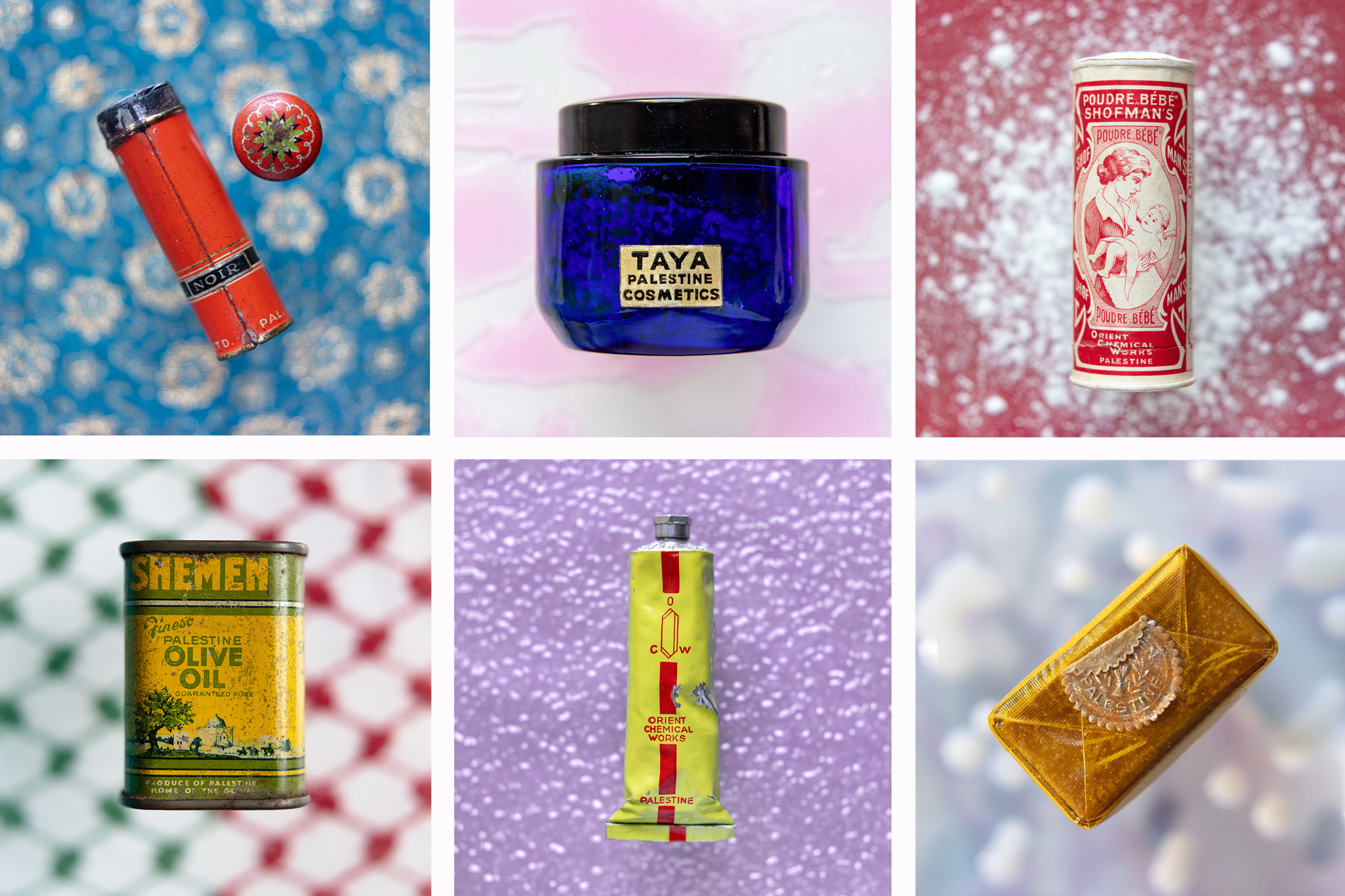
I made a series of close-up photographs of the vintage cosmetics, drawing from my collection of patterned vinyl, tiles, perspex and coloured backdrops and riffing on commercial product photography. I used droplets of coloured liquid and milk, and even sprinkled flour to recreate the look of baby powder. I love that I could incorporate and build on components of my existing art practice into this special project for Palestine. I made sure the labels were prominent in the images—seeing “Palestine” proudly printed on these vintage objects is powerful. These labels assert Palestine’s ongoing existence by serving as tangible, historical evidence of a land many still try to erase and refuse to officially recognise.
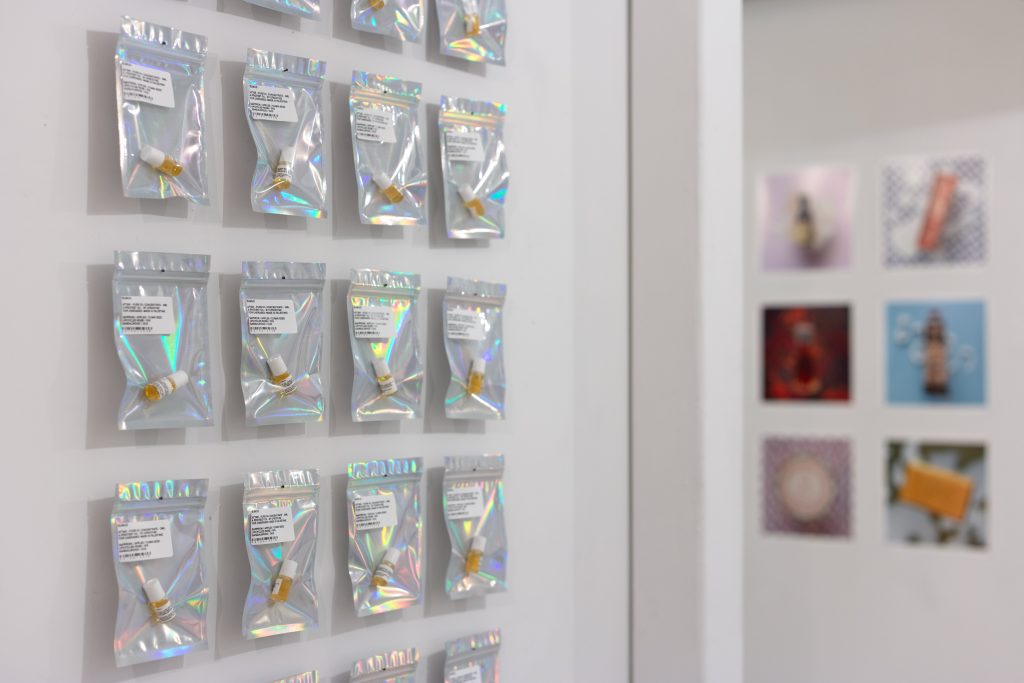
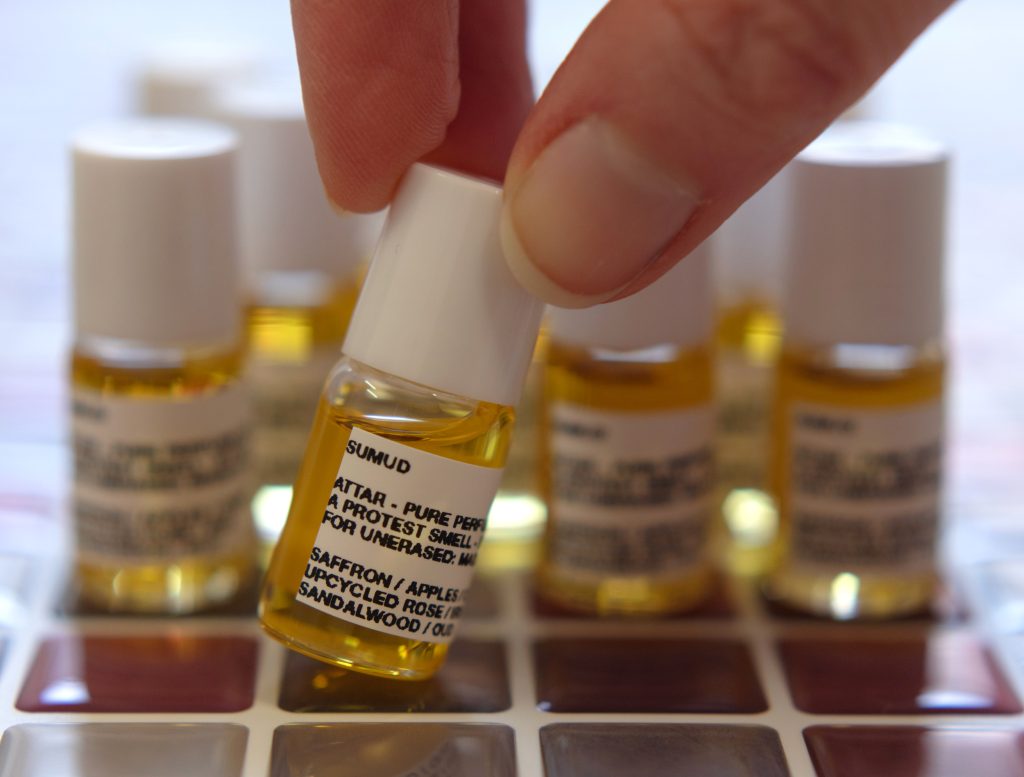
This project was also the perfect opportunity to collaborate with multi-disciplinary artist Nathan Taare, who uses scent to create immersive experiences. Nathan blends art, modern chemistry and tradition to make very special perfumes. For UNERASED: Made in Palestine, he developed SUMUD—an attar perfume oil. “Sumud” is an Arabic word meaning steadfastness, used by Palestinians to describe a form of resistance rooted in presence, endurance, and refusal to be erased. It is an animalic, spice-laden oud perfume—intense, unapologetic, and full-bodied. A throwback to traditional Middle Eastern and Indian compositions, it is deliberately bold: sharp with saffron, dirty with cumin, smoky with oud, softened only slightly by orris and rose. Lovingly handcrafted as a fragrant act of solidarity and resistance, this special scent stands in stark contrast to many luxury perfume brands with entrenched Israeli interests.
How did you connect with Maher?
Maher Nazzal and the Palestine Forum of New Zealand had developed an exhibition in Tāmaki Makaurau in May this year called UNERASED: The Palestine Experience. I had heard about this exhibition and was looking for a space to exhibit a new iteration of our project to bring it to a wider audience. We had shown the first version in Te Whanganui-a-Tara Wellington at Drive-Thru Gallery last year which was great, but knew we wanted to build on it, especially as Pinky had discovered even more objects since the first showing, which I was keen to photograph. I was actually put in touch with Maher through the pro-Palestine community on Instagram, and he was immediately keen to collaborate. So it quite naturally evolved to be part of the “UNERASED” exhibition series. We love that it utilises contemporary art combined with these vintage objects as a slightly different ‘way in’ to think about Palestine. I really hope people in the arts community also pay attention.
Looking at the items found in person, is quite confronting. Is this part of the point of the exhibition?
Yes, I can’t imagine how it must be for Palestinian’s to see these objects. One of the most significant examples is actually the tins of olive oil. The branding and wording on them is basically the same, except that the tin which is pre-1948 has “Palestine” as the country of origin, and the other, newer tin, says “Israel”. This particular company, called Shemen (the Hebrew word for oil), was established in 1906 and is attributed to a group of Hovevei Zion (Lovers of Zion) from Minsk, Russia. I found information online explaining that Shemen Industries put much effort into promoting and marketing the consumption of Palestine-turned-Israeli products, and was “among the first factories which played a major part in building the country of Israel”. A clear example of the mechanisms of settler colonialism.
What do you hope people take away? Is there anything else we can do to help this particular cause?
People can enter a $10 raffle to win the perfume and a photograph, buy prints and of course the fragrance. All proceeds will go to NZ charity Convoys of Good for families in Gaza. This is the link to the online store: https://madeinpalestineexhibition.bigcartel.com/
We just need to keep talking about Palestine. Go to rallies, connect with the community, email politicians. Don’t believe what’s happening is normal. Don’t look away. If it all seems overwhelming, boycotting products is something we can do everyday. History has shown that it works, when we look to apartheid South Africa.
What is your next step? Will there be any more shows or events?
We are hoping to take this exhibition to CoCA Toi Moroki in Ōtautahi Christchurch in a few months, so it will be great to bring it to a South Island audience. Maher is also developing another exhibition in the UNERASED series called Through Our Eyes which will be a photographic exhibition in Tāmaki Makaurau. Keep an eye out!
The exhibition is open 12-6pm at 250 Ponsonby Rd. It closes this Saturday 12th July, with a little closing celebration and raffle draw from 4-6pm that day. Please spread the word.